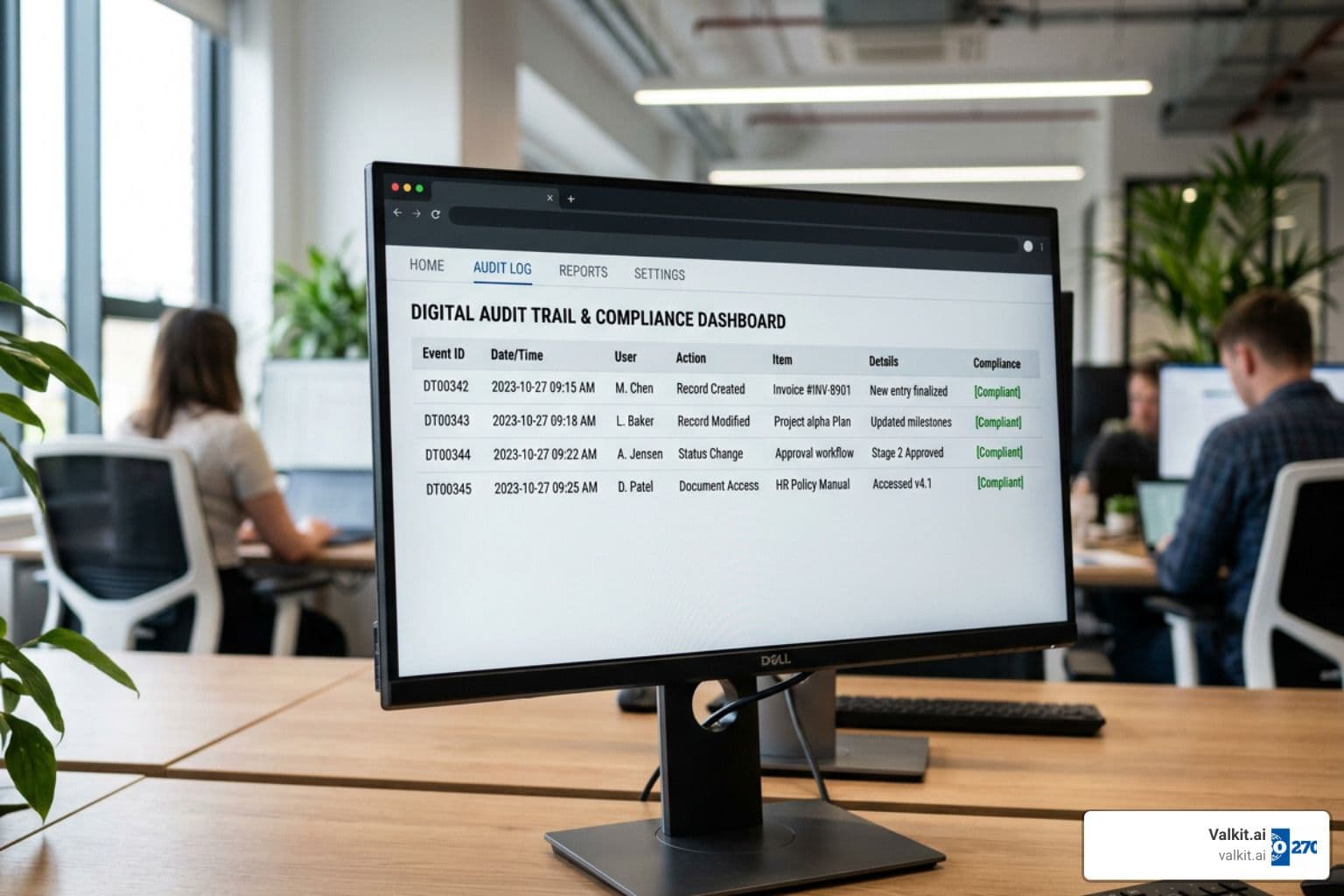
Why the Part 11 Audit Trail Is the Foundation of FDA Data Integrity
A Part 11 audit trail is one of the most scrutinized elements of any FDA inspection — and one of the most frequently cited sources of data integrity violations in warning letters.
Here's what you need to know at a glance:
Question Quick Answer What is it? A secure, computer-generated, time-stamped record of who created, modified, or deleted an electronic record, and when What regulation governs it? 21 CFR Part 11, specifically §11.10(e) Who needs it? Any FDA-regulated organization using electronic records in place of paper records required by predicate rules What must it capture? User identity, timestamp, action type, original value, new value, and reason for change Is it always required? Based on predicate rule requirements and a documented risk assessment What happens without it? FDA warning letters, Form 483 observations, and potential product recalls
Getting audit trails wrong isn't a minor paperwork issue. It can unravel batch disposition decisions, delay product releases, and put your entire compliance posture at risk — especially when an FDA investigator walks in and asks to see your electronic records.
Data integrity violations were a growing focus in FDA drug GMP warning letters in both FY2020 and FY2021, and audit trail failures remain one of the most cited reasons investigators issue warning letters today. According to multiple industry analyses, roughly 60% of data integrity-related warning letters between 2021 and 2024 involved some form of audit trail failure — whether that meant trails were never enabled, could be modified by administrators, or had simply never been reviewed by Quality Assurance.
This guide cuts through the regulatory complexity and gives you a clear, practical understanding of what a compliant Part 11 audit trail looks like, where organizations go wrong, and how to build a system that holds up under scrutiny every day — not just during inspections.
I'm Stephen Ferrell, Chief Product Officer at Valkit.ai, with over 20 years of hands-on experience in pharmaceutical quality systems, computerized system validation, and Part 11 audit trail compliance across hundreds of regulated organizations globally. As a contributing author to ISPE GAMP 5 Second Edition and chair of GAMP Americas, I'll walk you through everything you need to know to get this right.
What is a 21 CFR Part 11 Audit Trail and Why is it Required?
To understand the Part 11 audit trail, we must first look at what the FDA wants to achieve. When we transition from paper-based records to electronic records, we lose the physical cues of authenticity. You cannot see if someone erased a pencil mark on a digital screen, nor can you easily spot if a page in a database was swapped out.
To bridge this trust gap, the FDA enacted 21 CFR Part 11 in 1997. If you are new to this regulation, you can read our guide to Define 21 CFR Part 11 for a comprehensive foundation.
At its core, a Part 11 audit trail is a secure, computer-generated, time-stamped electronic record that reconstructs the lifecycle of your data. It acts as an independent "black box" recorder for your GxP software. Whenever a user creates, modifies, or deletes critical data, the system must silently and securely log that action.
This tracking is vital because it fulfills the core tenets of data integrity, often summarized by the FDA's ALCOA+ principles:
- Attributable: Identifying exactly who performed the action.
- Legible: Ensuring the history of the data can be read and understood years later.
- Contemporaneous: Recording the action at the exact moment it occurs.
- Original: Preserving the first recording of the data and all subsequent changes without obscuring the original.
- Accurate: Ensuring the recorded details match reality without unauthorized or undocumented alterations.
For a deeper dive into how these rules apply across systems like eQMS, LIMS, and manufacturing platforms, it is essential to understand the core definition and requirements of electronic records. The audit trail is required because it proves to regulatory inspectors that your electronic records are trustworthy, reliable, and legally equivalent to paper documents.
How Predicate Rules Define the Scope of a Part 11 Audit Trail
A common misconception is that 21 CFR Part 11 is a standalone rule that applies to every single computer in your facility. In reality, Part 11 only kicks in when a "predicate rule" requires you to maintain a record.
Predicate rules are the underlying FDA regulations governing your specific industry, such as:
- 21 CFR Part 211: Current Good Manufacturing Practice (cGMP) for finished pharmaceuticals.
- 21 CFR Part 820: Quality System Regulation (QSR) for medical devices.
- 21 CFR Part 58 / 312 / 50: Regulations governing Good Laboratory Practices (GLP) and Clinical Trials (GCP).
If a predicate rule states that you must document a specific activity—such as a batch weight, a laboratory test result, or an environmental monitoring measurement—and you choose to do so using an electronic system, then that system falls under the scope of Part 11. To understand how these manufacturing standards link directly to digital records, check out our resource on GMP CFR 21 Part 11.
If the predicate rule requires a record to be maintained, the corresponding Part 11 audit trail must be retained for at least as long as that subject record. If your batch records must be kept for seven years, your audit trail must also be kept—and remain readable—for seven years.
Understanding the Core Requirements of a Part 11 Audit Trail
When building or buying software for GxP environments, "checkbox compliance" will not save you during an inspection. We need to look closely at the exact wording of the law to understand what the FDA expects.
Under 21 CFR §11.10(e), the FDA outlines the specific controls required for closed systems. The regulation mandates the use of:
"...secure, computer-generated, time-stamped audit trails to independently record the date and time of operator entries and actions that create, modify, or delete electronic records. Record changes shall not obscure previously recorded information. Such audit trail documentation shall be retained for a period at least as long as that required for the subject electronic records and shall be available for agency review and copying."
Let's break this down into practical technical requirements:
- Secure: The audit trail must be protected from tampering, modification, or deletion by any user—including system administrators.
- Computer-Generated: The log must be written automatically by the system. Manual logs or user-prompted diaries do not count.
- Time-Stamped: Every entry must feature a precise, synchronized date and time.
- Independent: The audit trail must write to a separate table or storage location that cannot be bypassed by the primary application.
- Non-Obscuring: When a record is modified, the old value must remain fully visible alongside the new value. Overwriting or "saving over" data is a direct violation.
For a complete breakdown of how these rules govern your system validation, refer to our guide on the Requirements of 21 CFR Part 11.
The Technical Architecture of a Compliant Part 11 Audit Trail
To make an audit trail truly secure and compliant, we must look past the user interface and inspect the database architecture.
In basic software, audit trails are often handled at the application level. When a user clicks "Save," the application updates the record and writes a log entry to a history table. While this is simple to develop, it has a glaring vulnerability: anyone with direct access to the database (like an IT administrator or a database developer) can bypass the application, run a SQL query, and alter the data or the logs without leaving a trace.
To prevent this, critical GxP systems should employ database-level triggers or write-once-read-many (WORM) storage. Database-level triggers execute automatically within the database engine itself, logging any insert, update, or delete action regardless of whether it came from the application or a direct database connection.
Furthermore, modern systems utilize cryptographic hashing—such as SHA-256 hash chains—to create tamper-evident audit logs. Each log entry contains a mathematical hash of its own data combined with the hash of the preceding entry. If anyone alters a historical entry, the chain breaks, immediately alerting quality teams to the compromise. Achieving this level of security is a cornerstone of maintaining Pharma Data Integrity in modern digital facilities.
Key Components of §11.10(e) Compliance
What must a single audit trail entry actually contain to satisfy an inspector? Every compliant entry must answer five simple questions:
- Who did it?: The unique, non-shared user ID of the operator.
- What was changed?: The specific field or record, displaying both the original value and the new value.
- When did it happen?: A contemporaneous, synchronized timestamp.
- Why was it changed?: A documented reason for the change, which should be mandatory for modifications or deletions.
- Which action was taken?: Clarifying whether the record was created, modified, approved, or deleted.
When electronic signatures are applied, these metadata components must be permanently linked to the record. For more on signature requirements, see our guide on Electronic Signature Compliance Requirements.
System Classifications: Closed, Open, and Legacy Systems
How you implement your Part 11 audit trail depends heavily on how your system is classified under the law. The FDA distinguishes between open systems, closed systems, and legacy systems, applying different levels of control to each. Knowing where your software fits is the first step to becoming 21 CFR Part 11 Compliant.
To understand the official regulatory boundaries of these classifications, we always refer back to the FDA's landmark Guidance for Industry - Part 11, Electronic Records; Electronic Signatures — Scope and Application.
Closed vs. Open Systems
A closed system is an environment where system access is controlled by the persons responsible for the content of the electronic records on the system. Most internal platforms—such as an on-premise LIMS, an ERP, or a document management system managed by your internal IT department—are closed systems. The primary controls here rely on user access permissions, role-based security, and internal SOPs.
An open system is one where system access is not controlled by the persons responsible for the electronic records. Examples include submitting clinical data over the public internet or utilizing cloud-based SaaS systems where the vendor manages the infrastructure.
For open systems, the FDA mandates additional controls under §11.30, including:
- Data encryption: Protecting data in transit and at rest.
- Digital signatures: Using cryptographic certificates to guarantee authenticity and non-repudiation.
- SaaS Agreements: Clear, written agreements with cloud vendors defining access, security, and validation responsibilities.
Legacy Systems and Enforcement Discretion
What about old, reliable lab equipment or legacy systems that were operational before Part 11 became effective on August 20, 1997?
Under its enforcement discretion policy, the FDA does not intend to take regulatory action against legacy systems that do not fully meet the technical requirements of Part 11, provided they meet the following criteria:
- The system was operational before August 20, 1997.
- The system met all applicable predicate rule requirements before that date.
- You have documented, justified evidence (such as a formal risk assessment) showing that the system is fit for its intended use.
However, if you upgrade, modify, or replace a legacy system, it immediately loses its legacy status and must comply fully with Part 11. To determine if your older systems are candidates for this discretion, you must perform a structured Part 11 Risk Assessment.
FDA Inspection Trends and Common Warning Letter Citations
If you want to know what FDA investigators care about, look at what they cite in warning letters. Audit trail deficiencies are consistently among the top findings in regulatory audits.
During a 21 CFR Part 11 Audit, investigators do not just ask, "Do you have an audit trail?" They ask you to prove it is functional, secure, and actively reviewed.
During inspections, investigators routinely focus on whether systems allow users to bypass controls, whether administrators have unchecked power to alter logs, and whether QA is actually looking at the data.
The "Big Three" Audit Trail Failures
Over the last decade, FDA inspectors have identified three recurring audit trail failures across the life sciences industry:
- Shared Credentials: Allowing multiple operators to log in using a single account (e.g., "Admin" or "LabTech1"). This completely destroys attributability. If a critical batch parameter is modified, it is impossible to prove who did it.
- Disabled Audit Trails: Discovering that the audit trail functionality was turned off—either to improve system performance, to avoid writing error logs, or to hide unauthorized data changes.
- Lack of QA Review: Having a robust, validated audit trail but no documented evidence that Quality Assurance ever reviews it. If an audit trail is generated but never read, it fails to protect product quality.
To see how these failures translate into real-world regulatory citations and how to avoid them, read our curated list of 21 CFR Part 11 Examples.
Best Practices for Implementing and Validating Audit Trail Functionality
Achieving compliance requires a structured blend of technical controls, validation protocols, and procedural discipline.
When designing your compliance strategy, it is helpful to compare the FDA’s requirements with international standards. While Part 11 is the law of the land in the United States, many organizations exporting products must also comply with European standards, specifically EU GMP Annex 11.
Feature / Requirement FDA 21 CFR Part 11 (§11.10(e)) EU GMP Annex 11 (Section 9) Scope of Review Focuses on GxP records required by predicate rules Requires a documented risk assessment to define the scope of the trail Reason for Change Expected for modifications and deletions Explicitly mandates that the reason for change must be recorded System Access Focuses on securing the system from unauthorized changes Specifies that audit trail access must be read-only (even for Admins) Review Frequency Based on risk; critical data reviewed with each batch Demands regular, documented reviews based on system risk
To align your systems with both standards, we recommend following GAMP 5 (Good Automated Manufacturing Practice) guidelines. This involves transitioning from traditional, paper-heavy Computer System Validation (CSV) to the more modern, risk-based Computer Software Assurance (CSA) approach.
To dive deeper into this shift, explore our guide on Pharma Computer System Validation.
Additionally, always ensure your system clocks are synchronized to a validated, secure network time protocol (NTP) server. If your lab instruments, manufacturing equipment, and databases are even a few seconds out of sync, reconstructing a timeline of events during an investigation becomes an absolute nightmare.
Risk-Based Validation and Periodic Review
You do not need to validate every single log entry with the same intensity. Instead, apply a risk-based approach to your Installation Qualification, Operational Qualification, and Performance Qualification (IQ/OQ/PQ) protocols.
Focus your testing on critical data paths. For example, test what happens when a user attempts to delete a record, modify a batch parameter, or enter incorrect passwords. Verify that the system blocks unauthorized actions and logs authorized ones correctly.
Once validated, establish a clear SOP for periodic reviews. Critical data—such as laboratory results or manufacturing batch releases—should have their audit trails reviewed with every single batch before disposition. System-level audits (like login failures or configuration changes) can be reviewed on a periodic, monthly, or quarterly schedule. For more on structuring these validation cycles, check out our guide on 21 CFR Part 11 Validation Requirements.
Frequently Asked Questions about Part 11 Audit Trails
Can paper and electronic records coexist in a hybrid system?
Yes, they can, but hybrid systems represent a high-risk area during inspections. A hybrid system typically involves entering data into a computerized system and then printing out a paper copy for physical signature and archiving.
If you use a hybrid system, your SOPs must clearly define which format is the "authoritative record." If you rely on the electronic version for any part of your GxP activities, the electronic system must be fully Part 11 compliant—including its audit trail. You cannot use a printout to excuse a lack of data integrity controls on the computer itself.
How frequently should audit trails be reviewed?
Review frequency should always be determined by a documented, system-specific risk assessment.
- Critical Release Data: Audit trails for batch records, LIMS testing, and environmental monitoring should be reviewed alongside the data itself before a batch is released.
- Administrative Events: System-level events (such as user creation, password resets, or system configuration changes) can be reviewed periodically—typically monthly or quarterly.
- Low-Risk Systems: Training records or document management systems can be reviewed annually or during routine internal audits.
What is the difference between an event log and an audit trail?
This is a critical distinction that many IT professionals miss.
An event log tracks system-level functionality. It records when the software started, when a backup ran, or when a network error occurred.
An audit trail, on the other hand, tracks changes to GxP data. It records operator-initiated actions that create, modify, or delete specific records. An event log does not satisfy 21 CFR §11.10(e) unless it specifically captures the metadata of data modifications (who, what, when, and why).
Conclusion: Achieving Continuous Compliance with Valkit.ai
Achieving and maintaining compliance with Part 11 audit trail requirements does not have to mean drowning in endless paperwork or slowing your operations to a crawl. Traditional validation approaches often take weeks, cost thousands of dollars, and leave room for human error.
At Valkit.ai, we provide an AI-powered digital validation platform designed specifically for the pharmaceutical, biotech, and medical device industries. Operating from our hubs in Scotland and Indiana, we help organizations streamline their compliance workflows. Our smart automations, system cloning, and digital compliance tools reduce validation costs by up to 80% and compress execution timelines from weeks to mere hours.
Whether you are implementing a new LIMS, validating a complex manufacturing execution system, or remediating legacy software, we can help you build secure, automated, and audit-ready systems.
Ready to transform your validation process from a regulatory bottleneck into a competitive advantage? Request a demo with Valkit.ai today and see how easy compliance can be.